The Frame that changes the AI Learning Game: Introducing Tracey Cattana
I spent years studying how we actually learn, not as a side interest but as a professional discipline, and that shaped everything about how we teach, including the methodology we call FRAMED.
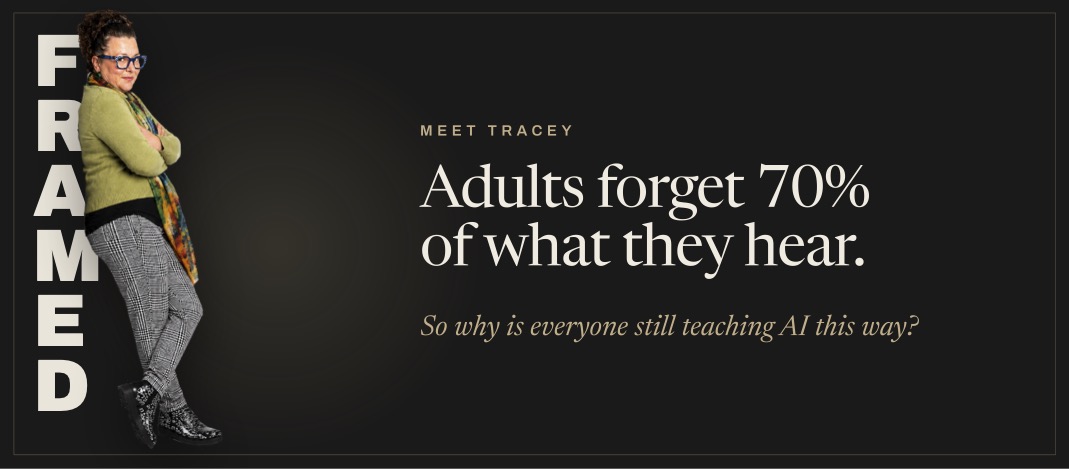
FRAMED stands for Frame, Relate, Activate, Model, Engage, and Deepen. Every lesson follows that sequence, because each step addresses something the research identifies as a genuine failure point in adult learning.
The lesson opens by framing what the learner will actually be able to do by the end, because adults absorb new information differently when they understand why it matters to their specific work.
Before introducing anything new, we connect it to what they already know, because that is how retention works.
The explicit teaching that follows is assumption-free, no jargon without a plain definition, because adults in a room full of technical vocabulary spend half their cognitive energy managing uncertainty rather than learning. Worked examples come before practice tasks, not after, because seeing exactly what good looks like is not spoon-feeding: It is respect for the learner's time.
The practice itself happens before the learner leaves the session, because adults forget roughly 70% of what they hear and retain what they actually do.
Reflection and troubleshooting are built into the close, so learners can self-correct when they hit something unfamiliar at work and do not need to come back with the same question twice.
The reason this matters for an AI course specifically is that the tools change fast, which means content knowledge has a shorter shelf life here than in most fields. What stays useful is the capacity to think clearly about what AI can and cannot do for your particular work, and that capacity comes from careful instruction, not from access to impressive demos.
We did not build FRAMED because the research on what actually produces durable capability in adult learners is unambiguous, and we were not willing to set it aside because recording a screen walkthrough is faster and cheaper than designing instruction that sticks.
We measure success differently here. Did the learner show up Monday and use what they learned on Friday? That question is harder to answer than a course completion rate, and answering it honestly is what drives how we design every course we teach.
Ready to apply this in your work?
Our live, mentor-led programs are built for professionals who want to use AI with more clarity, better judgment, and real outcomes.